|
|
CROMFORD IN POETRY AND PROSE
 |
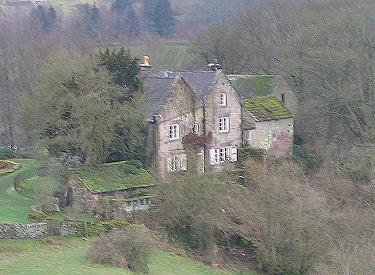
Castle Top Farm, Cromford, birthplace of Alison Uttley (1884 - 1976). A popular author of children's books, she also wrote about her idyllic childhood in Cromford. |
|
|
|
|
Modern poems about Cromford and its history
A CROMFORD PIECE Arkwright might well be surprised to learn his Cradle of the Industrial Revolution that Rocked him to fame while children tumbled, Over-tired, to early graves and exhausted Men and women sweated in the deafening clangs From water-frame and spinning-jenny has Outlived two hundred years and still stands, Redoubt-like, behind its towering walls. Doubtless, though, he wouldn't begin to understand how Politics have fashioned Cromford's decline to sideline his Inventive skills till his mill's reduced to Exhibition space, silent rooms, or rash of shops where Coach-loads of folk pick over imported clothes made Even cheaper in the sweatier shops of the Far East. Roger Elkin
TO CROMFORD Cromford, winding down a hill, cottage charm and pond of mill, swans, canal, a wharf, a wheel, a gentle place, historic feel, where Hargreaves 'Jenny' made her name, improved by Arkwright, man of fame. Bright shops a-plenty, rooms for tea, bored sheep and picnics, meadows free; Willersley Castle, quiet retreat, Institute where locals meet, a market square, the Greyhound pub, good car repairs to tyre and hub, then Scarthin Books, not least 'though last, to linger long through present past. Janet Martin
PUTTING CROMFORD ON THE MAP Look! This is where it all began, when two small-time craftsmen, makers of wigs and watches, meshed their talents with hairspring precision and wheeled in the Industrial Revolution. In this village, Richard Arkwright, that illiterate upstart, placed the first cog, that set the whole enterprise spinning. Power generating employment, employment generating wealth, wealth generating power. But look again. Where now are the vast arterial routes, that served the heatbeat of industry, the huge waterways, the great rail networks, encircling the country, circulating raw materials, distributing finished products? Listen! Can you hear faint footsteps in an empty yard, echoing voices at deserted looms, the rusty creaking of an idle wheel? Can you hear the coming of the fast train "Progress", shunting off the Steam Age down a disused siding? Maureen Sandler, 2000
|
From "Poets in England - Derbyshire" Headland Publications 1999 From "Eastern England Poets" Arrival Press 1995 |
|
|
ARKWRIGHT Lancashire man, from some back street, he scratched a living with false hair; and then his genius rose to meet, the shrewdness of his business flair. His spinning-jenny lit his dream, matching the world with eager fire; he staked his claim beside a stream deep in the dales of Derbyshire. His portrait shows a portly knight, prosperous, with kindly face - his factory now a tourist site, his mansion famed as a stay over place. Alan Robinson
Joseph Wright painted Sir Richard Arkwright, his son Richard Junior and his grandchildren, as well as views of Cromford Mill WRIGHT OF DERBY I think I shall commission Joseph Wright, that Derby man, now on the brink of fame; I hear that he shapes miracles with light, that art's perfection is his life's sole aim. The world is kocking at his studio door, the rich and famous coveting his skill; Sir Richard has been painted, and he swore that Wright can capture every fold and frill, and catch the very twinkle of an eye, or form men's faces as they truly are, or bring to life a landscape or a sky - for he surpasses other men by far. The work of Wright will last beyond his day, for countless years will still be on display. Alan Robinson
Hot air balloons are a common sight passing over Cromford Meadows. THE BALLOONS Slowly they glide along the dale a fleet of huge balloons, full sail. Now and again their burners blow, as with the swirling air they flow. Roof low almost, and tail to tree, their shadows moving stealthily. A riot of colour, splashing the hills, printed for trade with massive bills. They lift the heads of passers by who look in wonder at the sky. Crowding onward, they drift for home, passing the Tor with cool aplomb At last they course away and fade into the evening's falling shade. Alan Robinson
THE LEAD MEN OF WIRKSWORTH The new moot hall, a mere two hundred or so years old: the miners gathered here to settle their disputes, to keep the standard of their measures, to test the quality of their endeavour. Hard men they were, used to the life of the mole, as they hacked out the ore, and then blasted it white with heat. Their lead was almost indestructible and with infinite powers: buried in church roofing and bullets, and in water pipes and glass. The Romans garnered lead from the Peak and the skills passed on, like genes, down the generations. Yet, its richness is the gift of Greeks, so beware. As poisonous as a snake, the boon can destroy: as destructive as a tiger, the largesse of the ground can kill. Today there is still contradiction: petrol is fouled with it, but it is an armour against the potent death ray; it is in the beauty of pewter, and it coats the vicious power cable. Lead is like the human soul: hard to manage, and stained with the mark of Cain, but shining with God created possibilities. Alan Robinson
|
From "Poems of Peak and Dale" Athena Press 2002 From "Poems of Peak and Dale" Athena Press 2002 From "Poems of Peak and Dale" Athena Press 2002 From "Poems of Peak and Dale" Athena Press 2002 |
|
|
HILLSIDE, NEAR CROMFORD this mined hillside has settled for subsidence in grassed mounds and depressions, the worried pit-workings filled in, fenced off, concreted over: it has made its pocked peace; it and history have receded from each other low-heaped drystone walls mark the exhausted fields' excavations; an uprooted rail-track is decently glossed over by grass crags of stone-quarries, hills, lorried roads, a slag-heap houses' and chapel's slate roofs and stone walls, sunlight-faceted, crowd this ground around it supports its own life, of stumbling pasture, gullied scrub's bare berried branches for redwing, frost-green lichen, a roofless stone shed, its ruins of memory it has its place, this interlude among hills, a hemmed life's uneasy respite, green exemplar, for others to live off Alec Rapkin, 1993
|
|
|
|
A GENTLEMAN OF LONDON WRITES ABOUT HIS JOURNEYS IN THE MIDLANDS
In 1755 "a gentleman of London" with a companion undertook a journey through the midland counties and wrote Four Topographical Letters to his brother and sister about his experiences. On Thursday 24 July 1755 the travellers proceeded by chaise from Buxton via Pike Hall, Bonsall and Cromford to Matlock Bath. He describes Cromford as it was before Richard Arkwright went there to build his cotton spinning mills and changed its character for ever. The streams, springs and cascades of water were what attracted Arkwright there.
CROMFORD Travelling on, at length we descended the Hills to the Town call'd Bonsal, encompassed with high Rocks like Sea Cliffs: Passing through the Town, we went down a steep and rugged Hill, on the Left-hand of which runs a clear Rivulet, which, as it descended with great Impetuosity, form'd the most delightful natural Cascade I ever saw. From hence we passed along by this Chain of Rocks to Cromar, or Cromford, which is also surrounded by them: In this Town there is a large Smelting Furnace for Lead, which was the first we had seen, but had not Time to pay it a Visit. Many fine Chrystal Springs issue from the Rocks, which forming themselves into little meandering Streams, run thro' the Street, and joining at the Bottom of the Town, fall into the Darwent: I mention this Plenty of water, to lug in an Observation I made of an ingenious Blacksmith, who had contrived a Water-wheel on one of these Streams to turn his Grindstone. Travelling about Half a Mile further, we arrived at Matlock-Bath; and here we were made sufficient Amends for the Disappointment we suffer'd at Buxton. From "Four Topographical Letters" published in 1757, and reproduced in Travellers in Derbyshire, compiled by Marion Johnson.
|
This road was improved nearly 40 years later and named the Via Gellia. St Mary's Church is on the site of the furnace. The smithy was probably where the blacksmith's (now Elements) is now. |
|
|
THE MILLS AND SIR RICHARD ARKWRIGHTIn October 1778 the Derby Mercury published an item about a procession and a feast given by Sir Richard Arkwright for his mill workers at Cromford. A song, 'composed on the Occasion by one of the Workmen, was sung in full Chorus, amongst Thousands of Spectators from Matlock Bath, and the neighbouring Towns, who testified their Satisfaction at so pleasing a Sight.' SONG Tune - Roast Beef of Old EnglandYe Num'rous Assembly that make up this throng Spare your mirth for a Moment and list to my Song, The Bounties let's sing, that our Master belong, At the Cotton-Mills now at Cromford, The famous renown'd Cotton-Mills. You know he provides us a Feast once a Year, With Fruit, Cakes, and Liquor, our Spirits to cheer, He asks no return, but we decent appear, At the Cotton-Mills now at Cromford, The famous renown'd Cotton-Mills. Our Number we count seven Hundred or more, All cloathed and fed from his bountiful Store, Then Envy don't flout us, nor say any's poor, At the Cotton-Mills now at Cromford, The famous renown'd Cotton-Mills. Ye know we all ranged in Order have been, Such a Sight in all Europe sure never was seen, While Thousands did view us to complete the Scene, At the Cotton-Mills now at Cromford, The famous renown'd Cotton-Mills. Likewise for to make our Procession more grand, We were led in the Front by a Musical band, Who were paid from the fund of that bountiful Hand, At the Cotton-Mills now at Cromford, The famous renown'd Cotton-Mills. Ye Hungry and Naked all hither repair, No longer in Want don't remain in Despair, You'll meet with Employment, and each gets a Share, At the Cotton-Mills now at Cromford, The famous renown'd Cotton-Mills. Ye Crafts and Mechanics, if ye will draw nigh, No longer ye need to lack an Employ, And each duly paid, which is a great Joy, At the Cotton-Mills now at Cromford, The famous renown'd Cotton-Mills. To our noble Master, a bumper then fill, The matchless Inventor of this Cotton-Mill, Each toss off his Glass with a hearty Good-Will, With Huzza for the Mills now at Cromford, All join with a jovial Huzza.
SCAVENGER BOY Michael buys an old bobbin when his family moves into North Street in Cromford. He finds himself whirled back in time to 1781, when life in Cromford is very different. He takes the place of one of the young scavenger boys at the mill."A great creaking sound started up and with a whoosh the waterwheel beside the first mill started turning. Water flooded through deep-cut channels towards the second mill, where two more wheels groaned into action. It was a strange and terrifying place, this mill.
Michael glanced up at the great stone block of the second mill building. It stood seven storeys high, every window ablaze with candles and lamps. George and Jack stared just as he did. "Eeh, I've never seen owt like this before," George muttered. Jack said nothing, but his eyes were wide. "Haven't you worked in a mill before?" Michael asked. "Course not." George looked surprised at his question. "Great mills like this is a brand new thing. There's many as think they're wicked places, taking away poor home spinners' jobs. That's what Ma and Flora used to do." "Then why have you come here?" Michael asked. This fascinating book tells us how Michael fares as a scavenger boy, and how he makes his way back to present day Cromford.
|
From Scavenger Boy by Theresa Tomlinson Pub 2003 Walker Bros Ltd |
|
|
In 1790 Sir Richard Arkwright secured a charter for a Saturday market to be held in front of the Greyhound inn. John Byng visited Cromford that year, and found a eulogy pinned to the inn door. It was said to be written by an old woman, name unknown. SIR RICHARD ARKWRIGHT Come let us all here join in one, And thank him for all favours done; Lets thank him for all favours still Which he hath done besides the mill. Modestly drink liquor about, And see whose health you can find out; This will I chose before the rest Sir Richard Arkwright is the best. A few more words I have to say, Success to Cromford's market day.
|
|
|
|
Erasmus Darwin (1731-1802), the grandfather of Charles Darwin, earned his living as a doctor, but he also loved poetry and was fascinated by mechanics, science and nature. He had an optimistic view of industry and believed manufacturers could be forces for good in society. He was a friend and supporter of Richard Arkwright and an admirer of his machines. His long poem The Botanic Garden (1789) mixed poetry, science and radical ideas. Four thousand lines of rhyming couplets were divided into two parts, "The Economy of Vegetation" and "The Loves of the Plants". In the poem he described the spinning processes at Masson Mill. To modern eyes the language may seem over blown and the allusions difficult to understand.
THE BOTANIC GARDEN From "The Loves of the Plants"
So now, where Derwent guides his dusky floods
Through vaulted mountains, and a night of woods,
The Nymph, Gossypia, treads the velvet sod,
And warms with rosy smiles the watery God;
His ponderous oars to slender spindles turns,
And pours o'er massy wheels his foamy urns;
With playful charms her hoary lover wins,
And wields his trident,-while the Monarch spins.
-First with nice eye emerging Naiads cull
From leathery pods the vegetable wool;
With wiry teeth revolving cards release
The tangled knots, and smooth the ravell'd fleece;
Next moves the iron-hand with fingers fine,
Combs the wide card, and forms the eternal line;
Slow, with soft lips, the whirling Can acquires
The tender skeins, and wraps in rising spires;
With quicken'd pace successive rollers move,
And these retain, and those extend the rove:
Then fly the spoles, the rapid axles glow;-
And slowly circumvolves the labouring wheel below.
|
Gossypia - the personification of the cotton plant. Naiads - water nymphs. |
|
|
A TRAVELLER COMES UPON SIR RICHARD ARKWRIGHT'S FUNERAL; AND IS MET WITH INSOLENCE AT CROMFORD
On 10th August 1792, one J P Malcolm was riding from Chesterfield to Hopton, near Wirksworth. When he came within two miles of Matlock after a long and daunting journey over "the tops of rude, misshapen masses ... and desolate, dusty valleys" he heard the dismal tolling of a large bell. He was approaching down a hill which was higher than the Tor at Matlock, and was surprised to see that the Tor and rocks near it were covered with crowds of people. He passed through Matlock, over the bridge, and followed the road by the river at the foot of the Tor, discovering on the way that it was the day of Sir Richard Arkwight's funeral. "The road was now nearly impassable from the crowds of people and carriages; for Sir Richard Arkwright's funeral passed the Torr for Matlock Church, where he is to lie till a chapel now erecting, and begun by him, shall be finished. I no longer wondered at people on the rocks; a better opportunity of judging of the population of this place could not have offered, and it is surprisingly great. The ceremony was conducted with much pomp, and, as nearly as I can remember, was thus: a coach and four with the clergy; another with the pall-bearers; the hearse, covered with escutcheons, surrounded by mutes, followed; then the horse of the deceased, led by a servant; the relations, and about fifteen or twenty carriages, closed the procession, which was perhaps half a mile in length. The evening was gloomy, and the solemn stillness that reigned was only interrupted by the rumbling of the carriages and the gentle murmurs of the river; and as they passed, the echo of the Torr gently returned the sound. The whole was so rich and uncommon that I continued to gaze till a turn in the road closed the whole ... Such a variety is there at this place that a particular description is next to impossible. Imagine yourself on the hill, the river beneath, numberless trees in all the various forms that an obtructing rock or a want of support can occasion, a white rock towering far above you; the road, now leading to Cromford, makes a sudden turn close to it; a cotton mill, with a neat little turret, surrounded by trees, the massy wheel turning slowly, the water foaming from it; at some distance, Sir R Arkwright's house, like a vast castle, with its keep, etc., all embattled; farther, his mills, Cromford Bridge, and the new chapel; behind, a chain of hills, partly covered with wood; opposite the house a huge rock, fantastically adorned with shrubs and trees; through this rock the road is carried with much labour. Such is the scene on leaving Matlock. Proceeding, a long rough hill, lined by new stone houses, makes the traveller regret what he has left. Much to Sir Richard's credit, those habitations are most comfortable. And, if one may judge of prosperity by the insolence met with on this hill (from those who had been to gape at the funeral), surely Cromford is a happy place; but let it be understood, that I believe the holiday had produced this redundancy of wit. After an unpleasant ride over rough ways, which still are compensated by the rich views of Matlock and Sir Richard Arkwright's house, I arrived at Hopton, the hospitable mansion of Mr. Gell, much pleased with my route.
This is part of an article published in The Gentleman's Magazine, 1793 Part 1, which is reproduced in Travellers in Derbyshire, compiled by Marion Johnson.
|
High Tor. Matlock church is at the back of the Tor. Masson Mill Willersley Castle Scarthin Tor and Scarthin Nick - (The crossroads) Cromford Hill
|
|
h h h h h h h h |
When the closure of Masson Mill was announced in 1991, the following anonymous poem was pinned to the mill's notice board. Will anyone own up to writing it? MASSON MILL I've stood upon this riverbank, Two hundred years and more, Whilst thousands, oft in serried ranks, Have hurried to my door; I bade them all to come within; To toil, to sweat and slave, Their pathway to prosperity, In return I'd pave. Generations came to spend, In me their working lives, Sworn enemies and bosom friends, Sons, daughters, husbands, wives; From miles around to me they came, I took them, strong or weak, When old, I'd set them free again, An easier life to seek. Now time, the master of us all, Has swung his blade on me, King Cotton soon alas will fall, His mill no more I'll be; His lengthy reign will soon be done, In this fair Derwent Vale, Where countless miles of yarn have run, Now silence will prevail. My passing wil
l be
sad I know, Yet, one or two may cheer, Many though, with spirits low, Will shed a silent tear; But as my life draws near its peak, And man's composure fails, You may see tears roll down the cheeks, Of those as hard as nails. To all who've known me from within, I have just this to say, Should you pass close by me again, Turn and look my way, Gaze upon my empty shell, Curse me if you will, But I vow you'll all remember well, Your time in Masson Mill. Anon
Back to History Page ^Back to the top
|
In 1999 Masson Mill opened as a Shopping Village, with four floors of shopping, a self-service Restaurant, conference facilities and a Textile Museum. |
|
|
WILLERSLEY CASTLEThe Hon John Byng, later Viscount Torrington, travelled in England during the course of 13 years and kept a diary of his journeys. Byng disliked modern buildings, and was not impressed by Sir Richard Arkwright's new house, which he visited in June 1789, describing it with some sarcasm. "We took a meand'ring walk around these little mills, bridges, and cascades; and went to where Sir R: A is building for himself a grand house (Wensley Castle) in the same castellated stile as one sees at Clapham; and really he had made a happy choice of ground, for by sticking it up on an unsafe bank, he contrives to overlook, not see, the beauties of the river, and the surrounding scenery. It is the house of an overseer surveying the works, not of a gentleman wishing for retirement and quiet. But light come, light go, Sir Richard has honourably made his great fortune; and so let him still live in a great cotton mill! But his grateful country must adore his inventions." A year later, in June 1790, Byng revisited the house and his opinion did not change."I took a short walk to look at the weather, and at Sr Rd A's new house. The inside is now finishing; and it is really, within, an effort of inconvenient ill taste; built so high as to overlook every beauty, and to catch every wind; the approach is dangerous; the ceilings are of gew-gaw fret work; the small circular stair-case, like some in the new built houses of Marybone, is so dark and narrow, that people cannot pass each other; I ask'd a workman if there was a library? - Yes, anser'd he, at the foot of the stairs. Its dimensions are 15 feet square; (a small counting house;) and having the perpendicular lime stone rock within 4 yards, it is too dark to read or write in wothout a candle! There is likewise a music room; this is upstairs, is 18 feet square, and will have a large organ in it: what a scheme! What confinement! At Clapham they can produce nothing equal to this, where ground is sold by the yard." Were Byng's comments inspired by snobbishness, and perhaps envy? What a thought!
|
|
|
|
A DESCRIPTION OF WILLERSLEY CASTLE From Pigot and Co's Commercial Directory of 1835 Willersley castle, the beautiful seat of Richard Arkwright, Esq. stands on the south side of a commanding eminence, which terminates the extensive range of rocks that forms the eastern boundary of the Derwent in its course through Matlock dale: the castle consists of a body, in the form of an oblong square, having a circular tower rising from the centre of the roof, and semi-circular ones projecting from the entrance and the two wings, with a round tower at each angle: the whole edifice is embattled, and the exterior of white free stone. This building was erected by the late Sir Richard Arkwright, in the year 1782; & on the 8th August, 1791, the house (before it was inhabited) was, by an overheated stove, set on fire, and the combustible part consumed. The present mansion is furnished with great taste and neatness; the gardens and walks are most judiciously laid out, and the plantations are rich and extensive; the gardens are opened to the public every Monday and Thursday.
|
|
|
|
|
|
|
|
LEA ROAD AND CROMFORD BRIDGE This is a story collected by Ruth Tongue and is taken from her book "Forgotten Folk-Tales of the English Counties", published by Routledge & Kegan Paul in 1970. It was heard by her on a picnic on Masson, Matlock, in 1927, and presumably she wrote it down in her own style. It is reproduced in a collection of folk tales by Katharine Briggs, and is retold on an American website from that book. I have not found any earlier versions of the story. My comments are in green in the right hand column. CROOKER A traveller was on his way to Cromford late in the evening when an old woman came from the hillside and met him. "And where are you bound for so late?" she asked. "The sun has gone down, and it will soon be dark. This is no road to travel at night." He was silent, and then she said, "I see you are wise enough not to speak and put yourself in danger, but I doubt if you'll be safe from Crooker without any of the right kind of help." He looked at her in the after-light and saw she was holding out a posy to him. He hesitated, for it seemed as if she were dressed in green, but then he saw the posy was St John's Wort. The old woman nodded. "I wish you well," she said. "You once freed a bird from a fowler's net. I knew that bird. Take the posy and when you travel Cromford Road show it to Crooker." "Who is Crooker?" said the traveller. But the old woman was gone. He was all alone with the posy in his hand. "That was an honest warning," he thought. "But I must go on to Cromford for all that." And he went on his way. Another old woman was waiting for him on the lane side and though it was getting dark he thought she was dressed in green and held a posy of primroses. "No one travels Cromford Road at night," she said. "I must," he said, for he knew by the posy she wished him well. "My old mother is ill and needs me." "Then show these to Crooker," said she as he took the second posy. "You freed a rabbit from a snare. I knew that rabbit. And you need the right kind of help." "Who is Crooker?" asked the traveller, but she too was gone and he was all alone. "It will be dark before moonrise", said the traveller. "I doubt I'll need my two posies on the road. That was some more honest help but I'd feel even safer with three. I must hasten." And he went into the dusk. At a bend in the lane he met a third old woman in green holding a posy of daisies. "'Tis a dark and dangerous time to travel Cromford Road," she said. "You can do with the right kind of help. Take the posy and show it to Crooker." "Who is Crooker?" asked the traveller. She did not answer, but said, "You freed a vixen and her cub from a trap. I knew that cub and that vixen. So here's a second bit of advice. Keep as far from the Darrent River as you can and Cromford Road runs beside it. You must be on Cromford Bridge before the moon rises." And then she too went away into the hill and there he was all alone with his three magic flower posies. "I'll need these," he thought. "Honest help never comes amiss. But I am so weary I doubt if I'll reach the shrine on Cromford Bridge before moonrise. I'd be glad of its light, for they say Darrent runs fast and deep and I'd not like to miss my footing and fall in." But when at last he came to Cromford Road the moon was high overhead and very bright. The river swirled by just below and there were great trees on the bank above the road. They cast strange, muddling shadows that moved in the breeze.
"I don't like the look of those moving branches," said the traveller. "There's one tree all by itself that frightens me; its shadows look like skinny, clutching hands. I'm close to Cromford Bridge now. I'll run past it." And for all his weariness he did. Then the river began to ripple loudly as if it were crying "Hungry!" and on the moonlit road before him he saw the chasing shadow of long crooked hands like branches. "Crooker," gasped the traveller and without looking back he hurled the posy of daisies over his left shoulder on to the road. The shadow disappeared. Darrent River cried "Give!" and there was a splash. The terrified traveller began a hobbling run for the safety of the bridge and its shrine, but once more the chasing shadow of Crooker came onto the road in front of him and he hurled the posy of primroses over his left shoulder. Crooker stopped. Darrent River cried "Give!" and there was a second splash. Fear lent wings to the traveller's weary feet. He was almost at the bridge itself when once more the clutching shadow lay across his way. With his last strength he turned right round and flung the posy of St John's Wort straight at the wicked tree. It cried out terribly as the traveller gave a despairing leap on to Cromford Bridge and fell in a swoon at the foot of the shrine.   Darrant River roared and moaned and the good people of Cromford looked at each other white-faced. "Darrant and Crooker", they whispered. "We must go at sunrise and get the priest. There'll be another dead for churchyard." "D'you remember the old beggar woman we found with a broken neck? Drowned in Darrent one night she was. He roared then." But when they came to Cromford Bridge in bright sunlight there was a pale footsore traveller saying his prayers at the shrine. He got up stiffly and hobbled on his way to the village, while Darrent River ran shallow and sunny below the bank where a great ash tree stood.
Heard in 1927 at a picnic on Masson, Matlock.
Ruth Tongue's Footnotes: Darrent is the River Derwent. It is very dangerous, being fast-flowing and full of pot-holes, and, like the Dart, has a murderous reputation. However, a mediaevel bridge and shrine provided safety. The Cromford Road also has a sinister tradition. At the time this story was told, (1927), there was a tree by the river with a most unpleasant shadow, and near-escapes from drowning along this stretch are frequently mentioned. One early winter evening an acquaintance had returned from London and started to walk home to Matlock Bath from Cromford Station, knowing nothing of its tradition. The moon was full but scuds of cloud and swathes of thin mist obscured the road at times. They walked rapidly and well away from the hedge on the riverside, bearing in mind that the sudden cloud shadows could be confusing. The moon came out suddenly from behind a cloud and they found they had swerved towards the Derwent and were only a yard or so from a gap in its bank and hedge, and lying across the road was the menacing shadow of a dead tree. They were suddenly seized with panic and sprinted to the open safety of Cromford Bridge. They never went home by Cromford Station after dark but preferred the extra fare and bus back to Matlock Bath.
|
The traveller was walking down Willersley Lane, the old route from Matlock via Starkholmes. River Derwent Cromford Road is Lea Road, which runs by the river. The 'shrine', or Bridge Chapel, is at the further side of the bridge. In July 2002 complaints were made to the parish council about lack of lighting and overhanging shrubbery on Lea Road between the station and the bridge. |
|
|
Edward Boaden Thomas wrote an epic prose poem "The Twelve Parts of Derbyshire", a journey through the county's geography and history, published in 1988. He approached Cromford from Starkholmes, the same road travelled by the hero of "Crooker". CROMFORDThis breakneck and twisting road at Starkholmes Is checked on a shelf above the valley; Here you may turn to the south for Cromford The way at first being on a level, And thus at this late stage in your travel Revealing below you the limestone dale At Matlock Bath so familiar to all. But soon your road in its turn goes downward Uninterruptedly now till you reach A main road near the crossing of Derwent. Further along, a rock mass on one side Carries a house; a mill on the other More than is usual looks impregnable Like a stern fortress; and both those buildings Belonged to the famed Arkwright family Lords of the Industrial Revolution Here in this battered picturesque valley Where came the canal, the water-power And roads that have not ceased getting wider, Converging together where the Twelfth Part ends.
|
Views over Matlock Bath. Willersley Lane to Lea Road. Rock House & Cromford Mill. And the railway. |
|
|
The writer Alison Uttley was born in 1884 at Castle Top Farm, where she spent her childhood. The farm is on the hillside above Lea Road on the edge of Cromford. The following extracts are from her book "Country Things", and describe the road which so frightened the traveller by moonlight in the "Crooker" story. COUNTRY ROADS There are many roads I know well in many counties, but the one I travel along in my dreams is the country road to the village, where I was carried to my christening. There I jogged in the cart, and drove in the little swift-moving pony-trap, a thousand times. It was no dull stretch of macadam, but a jolly little country road, called "The Bottom" - for all good roads and lanes have names, like Christian people. "The Bottom" is the old name for a valley road. Parallel with it ran the river, which was divided from it by a strip of flowery meadow, and a low little wall, so richly encrusted with tawny-yellow stonecrops and dove's foot, with herb robert and harebells and the tiny flower of the ivy-leafed toad-flax, that it was a veritable rock garden, a tapestry of closely woven colour. On the other side of the road were the hedges and fields... The narrow strip of meadow by the riverside held our attention, and everybody who drove along the road turned his head to gaze at the beauty of water and water-meadow. The thick grass was bright with field flowers, rich with colour and the heavy scent of herbage. There were white violets which we could smell without seeing, bluebells, and forget-me-nots, red campion, foxgloves, meadow sweet and dog daisy, wild rose and blue geranium, and many rank water plants. These bordered the tossing, swirling river, which foamed white round the black shining stones in its bed... The river was spanned by an old stone bridge, and my heart always beat a little faster as I went over it... Centuries ago, tradition said, a little priest's house or chapel had been there, where a monk lived who took people across the ford.
|
Lea Road. Across the river is Cromford Meadows. |
|
|
FLORENCE NIGHTINGALE Cromford Bridge House is on Lea Road, described by Alison Uttley in Country Roads. The house belonged to the Nightingale family and was the home of Elizabeth Evans, the great aunt of Florence Nightingale. In 1852 Florence nursed her aunt through her last illness. At her aunt's death Florence was offered Bridge House to turn into a hospital, but she refused and
two years later was appointed superintendent of nurses in military hospitals during the Crimean War. Florence Nightingale became a celebratory and the image of her as "the lady with the lamp" was
popularised by Longfellow in his 11 verse poem Santa Filomena. From: St Filomena, by Henry Wadsworth Longfellow.
|
|
|
LIVING ON IN MEMORY |
MEMORIAL INSCRIPTIONSSt Mark's Church was built in 1874 as a mortuary chapel with graveyard and for occasional services. Before that burials took place at Wirksworth cemetery, only members of the Arkwright family were interred at St Mary's Church. St Mark's became unsafe due to subsidence and was demolished in the 1960s. The graveyard continued to be used until recently when burials were transferred to the new cemetery at Steeple Grange, Wirksworth. Many of the gravestones in St Mark's cemetery have inscriptions, a line or verse, in memory of the loved one. Some were commonly-used verses but others were penned by the family. They show a strong sense of grief, but find consolation in the belief that the soul will find peace in Heaven, to be reunited with those gone before and those to follow. Some of the longer verses are recorded below, with the name of the deceased to the right.
**********He is gone, but love still lingers Round his memory dear. In the hearts of those remaining He is ever near. ***
|
Robert Hall died 30 May 1896 Aged 48 |
|
A GOOD PERSON |
She had a nature so loving A heart that was purer than gold And to those who knew her and loved her Her memory will never grow old.*** Mark the perfect man, and behold the upright for the end of that man is peace. ***
|
Fanny Mee died Sept 28th 1945 Aged 72 Samuel Walker died Nov 19th 1894 Aged 70 |
|
PEACE AFTER PAIN |
In death's soft slumbers Lull'd to rest The suffering frame no more distressed lies safely, and in peace. In hope of a joyful resurrection to Eternal life.*** Rest comes, though life be long and dreary The day must dawn, and darksome night be past All journeys end, in welcome to the weary And heaven's true home will come at last. *** |
Mary Ratcliff died Aug 25th 1882 Aged 76 William Kniveton died June 7th 1903 Aged 62 |
|
TO HEAVENLY REST |
The evening stars shine o'er the grave Of him we loved but could not save From earthly pain to Heavenly rest Missed by those who loved him best.*** My flesh and my heart faileth But God is the strength of my and my portion for ever. *** |
Henry Wilbraham died March 15th 1919 Aged 28 James Swift died 10th Feb 1886 Aged 65 |
|
UNITED WITH LOVED ONES WITH JESUS |
My weary limbs are now at rest Sufferings and pain with me are o'er I go to meet my friends whom God hath blest In Heaven where we shall part no more.*** For our loss we must not weep Nor our loved one long to keep From the home of rest and peace Where all sin and sorrow cease. *** I came to Jesus as I was weary and worn and sad I found in Him a resting place And He has made me glad.*** |
William Britland died Dec 12th 1890 Aged 60 John Taylor died Aug 29th 1902 Aged 65 Emily Ratcliffe died Dec 7th 1899 Aged 44 |
|
|
Thou art gone to the grave But we will not deplore thee Though sudden the message That led to the tomb Thy Saviour has passed Through its portals before thee And the lamp of His love Is thy light through the gloom.*** I will love thee in life, I will love thee in death And praise thee as long as thou givest me breath And say when the death-dew lies cold on my brow If ever I loved thee my Jesus 'tis now. *** |
Thomas Smith died May 28th 1881 Aged 23 William Sutton died August 4th 1882 Aged 61 |
|
IN HOPE OF RESURRECTION |
Absent from the body, present with the Lord My flesh also shall rest in hope.
*** |
Eliza Brocksop died Jan 18th 1868 Aged 52 |
|
CHILDREN |
The first sheaf of the harvest Sleep on dear babe, thy narrow cell Becomes its earthly tenant well Soon shall the resurrection morn With glory's robes thy dust adorn.*** And with the morn Those Angel faces smile Which we have loved long since And lost awhile. *** Your angel face we loved to view But soon we were deprived of you Adieu sweet child and take your rest God calls them first that He loves best. *** Two hearts entwined stopped beating Two sweethearts laid to rest God's garden must be beautiful For He only takes the best. **********

|
John Holmes died March 31st 1877 Aged 6 months George Herbert Doxey died Nov 4th 1900 Aged 8 months Henry Boden died Nov 22nd 1918 Aged 6 years & 4 months Lorraine Underwood Aged 15 Peter Thompson Aged 18 Died April 15 1979
|
|
|
|
|